
Reading day-7 retention without fooling yourself
Day-7 retention is the number every game studio quotes. Here are four ways it lies, and how Cadence shows the real curve.
On this page3 sections
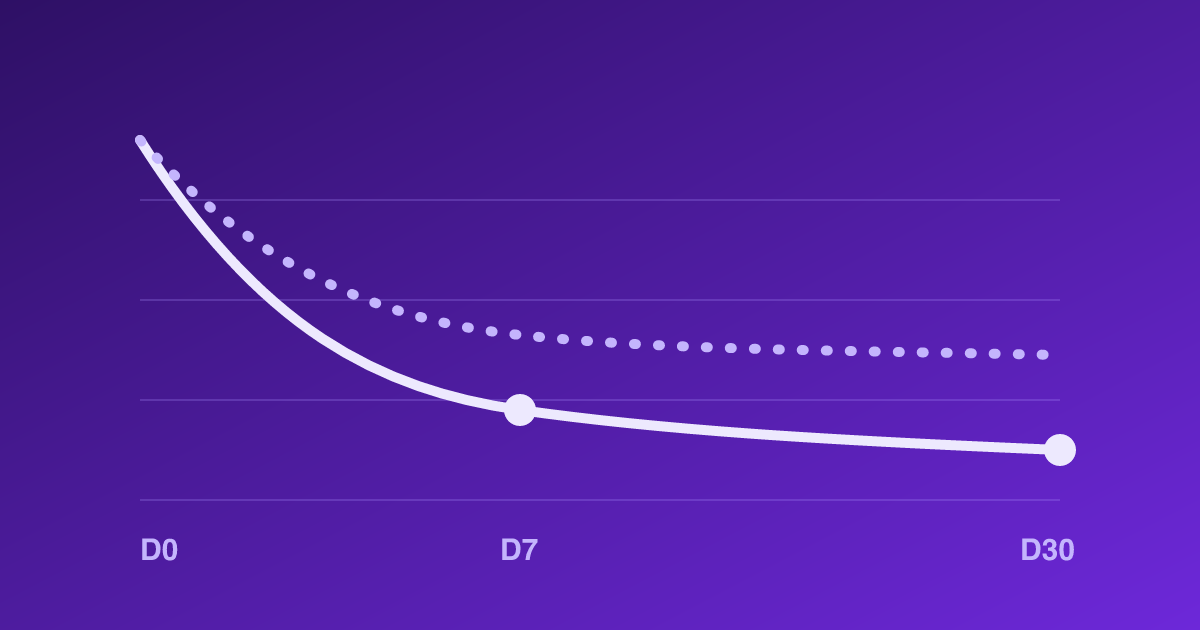
Every publisher call starts with the same question: what’s your D7? It’s a good number to ask for. It’s also easy to get wrong without noticing.
Classic or rolling
Classic D7 counts players who opened the game exactly on day 7 after install. Rolling D7 counts players who opened it on day 7 or any day after. Rolling is always higher, often by 5 to 8 points for a casual puzzle game.
Neither is wrong. Mixing them is. Cadence labels every retention chart with the method, and the default is classic because that’s what most publishers mean.
Four ways the number lies
- Install cohorts that are too small. Below about 500 installs a day, D7 swings by several points from noise alone. Group by week instead.
- Paid and organic in one cohort. A burst of cheap paid installs drags D7 down for a week, then it “recovers”. Split by acquisition source first.
- Time zones. A day is a calendar day in the player’s time zone, not UTC. Counting in UTC moves late-evening sessions into the wrong day.
- Reinstalls. A player who deletes and reinstalls is not a new player. Cadence matches them on the device ID you send and keeps their original install date.
What a healthy curve looks like
For a free-to-play mobile game, a D1 around 40% and a D7 around 15% is a solid start. The shape matters more than the points. A curve that flattens after day 14 means you have a core audience. A curve that keeps sliding means you don’t yet.